Chinese Business Scope (经营范围): Manufacturing vs Trading Terms
A glossary of the Chinese business-scope terms that separate a manufacturer from a trading company — the production verbs, the trade verbs, and how to weigh them.

The business scope (经营范围) on a Chinese licence is written in Chinese, in a few dense lines, and it is the single field that most quickly separates a manufacturer from a trading company. You do not need to read Chinese fluently — you need to recognise a short list of terms. Here is that list.
Quick answer
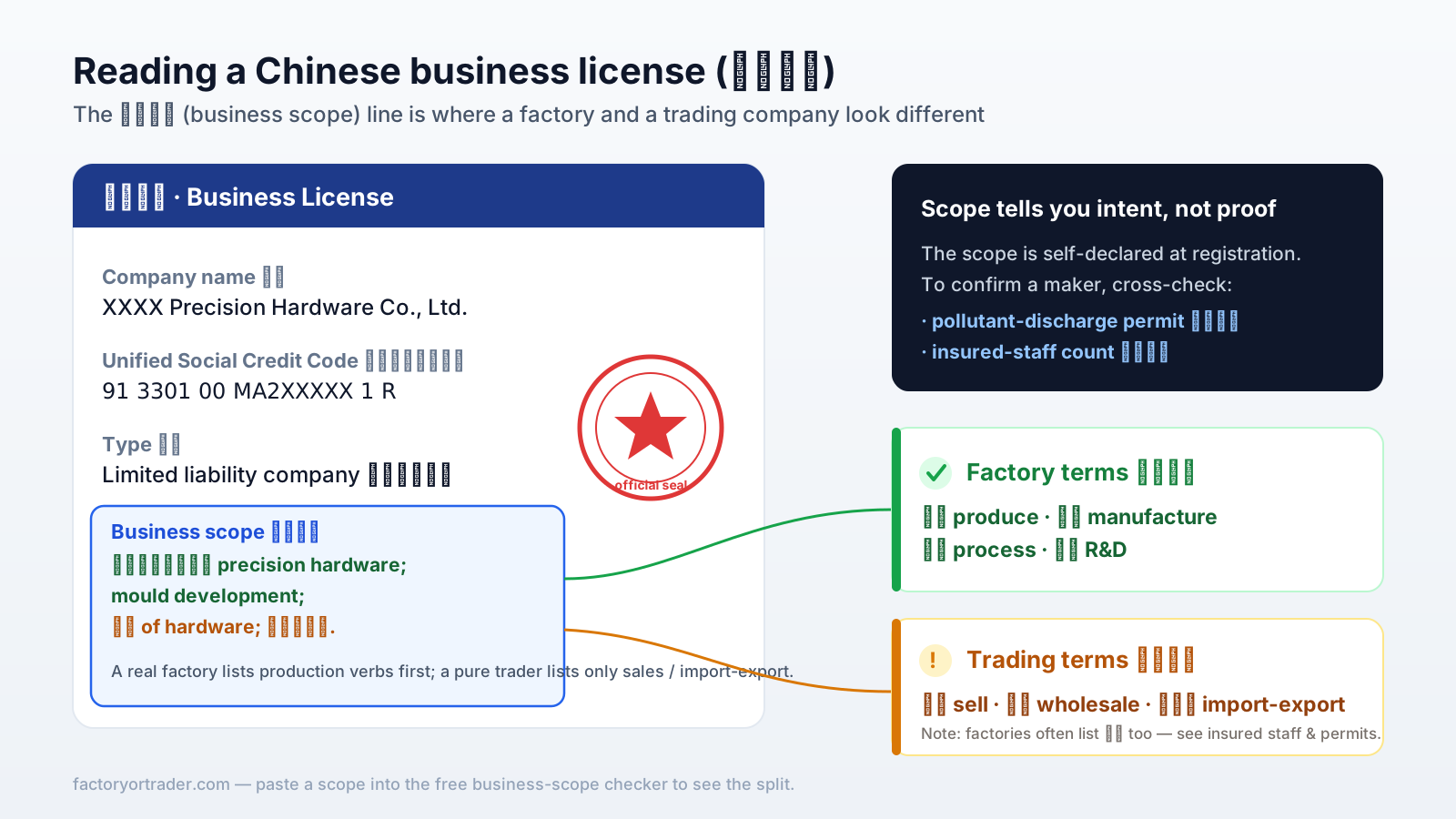
On a Chinese business licence, the business scope (经营范围) lists what the company registered to do. Manufacturing terms — 生产 (produce), 制造 (manufacture), 加工 (process), 研发 (develop) — mark a maker. Trading terms — 销售 (sell), 批发 (wholesale), 零售 (retail), 进出口 / 货物进出口 (import-export) — mark trade. A real factory leads with production verbs tied to a specific product; a pure trader lists only sales and import-export. The scope shows intent, so confirm a maker with its permits and insured staff.
Manufacturing terms (a maker registers these)
| Term | Pinyin | Meaning | | ----------- | ------------- | -------------------- | | 生产 | shēngchǎn | produce / production | | 制造 | zhìzào | manufacture | | 加工 | jiāgōng | process / fabricate | | 研发 / 开发 | yánfā / kāifā | research & develop | | 装配 | zhuāngpèi | assemble |
When these appear with a specific product — for example "生产 precision hardware" or "制造 LED lighting" — the company registered as a producer of that item. That is the signal you want.
Trading terms (a reseller registers these)
| Term | Pinyin | Meaning | | ------------------- | --------- | ---------------------- | | 销售 | xiāoshòu | sell / sales | | 批发 | pīfā | wholesale | | 零售 | língshòu | retail | | 贸易 | màoyì | trade | | 进出口 / 货物进出口 | jìnchūkǒu | import-export of goods | | 代理 | dàilǐ | act as agent |
A scope built only from these verbs — "销售 of hardware; 货物进出口" with no production item — describes a company that moves goods rather than makes them.
How to weigh them (it is not just keyword-matching)
The terms are the start, not the verdict. Read them with three rules:
- Read the object, not just the verb. "生产、销售 precision moulds" is a maker that also sells its own output — normal for a factory. "销售 moulds; 进出口" with no production verb is a trader.
- Factories list 销售 too. Almost every manufacturer registers sales of its own products, and large groups split production and export into separate entities (工贸分离). Seeing 销售 does not demote a company to trader.
- Scope is self-declared. It shows what the company registered to do, not proof it does it. To confirm a maker, add the records a trader can't fake — a pollutant-discharge permit and an insured workforce.
Paste any scope into the free business scope checker to see the production and trade terms separated automatically, and read the fuller method in how to read a Chinese business license.
From scope to a verdict
The scope narrows it; the other official records settle it. A company with production verbs and a discharge permit and an insured workforce is a maker; sales-only terms with none of those is a reseller. That combination is the heart of telling a factory from a trading company, drawn from the 5 official records.
FAQ
What does 经营范围 mean on a Chinese business licence? It is the "business scope" — the list of activities the company is registered to perform, written in Chinese. It is where manufacturing and trading companies look different.
Which Chinese words mean a company is a manufacturer? 生产 (produce), 制造 (manufacture), 加工 (process), 研发 (develop), tied to a specific product. Sales-and-trade-only scopes use 销售, 批发, 贸易 and 进出口.
If the scope says 销售, is the company a trader? Not on its own — factories register sales of their own goods. Weigh 销售 against production verbs, a discharge permit and insured staff before deciding.
Can the business scope be faked? The registered scope is public, so a forged licence won't match the official record. Decode the USCC and confirm the scope in the registry.
Read any scope in one click
You don't have to translate it yourself. Paste a supplier's scope into the free business scope checker, decode its USCC, and when it matters, let the full records decide.