Is Your Chinese Supplier a Factory or a Trading Company? (2026 Guide)
A practical 2026 guide to telling a real Chinese factory from a trading company, using the business licence, business scope, official permits and the USCC — not the Alibaba badge.
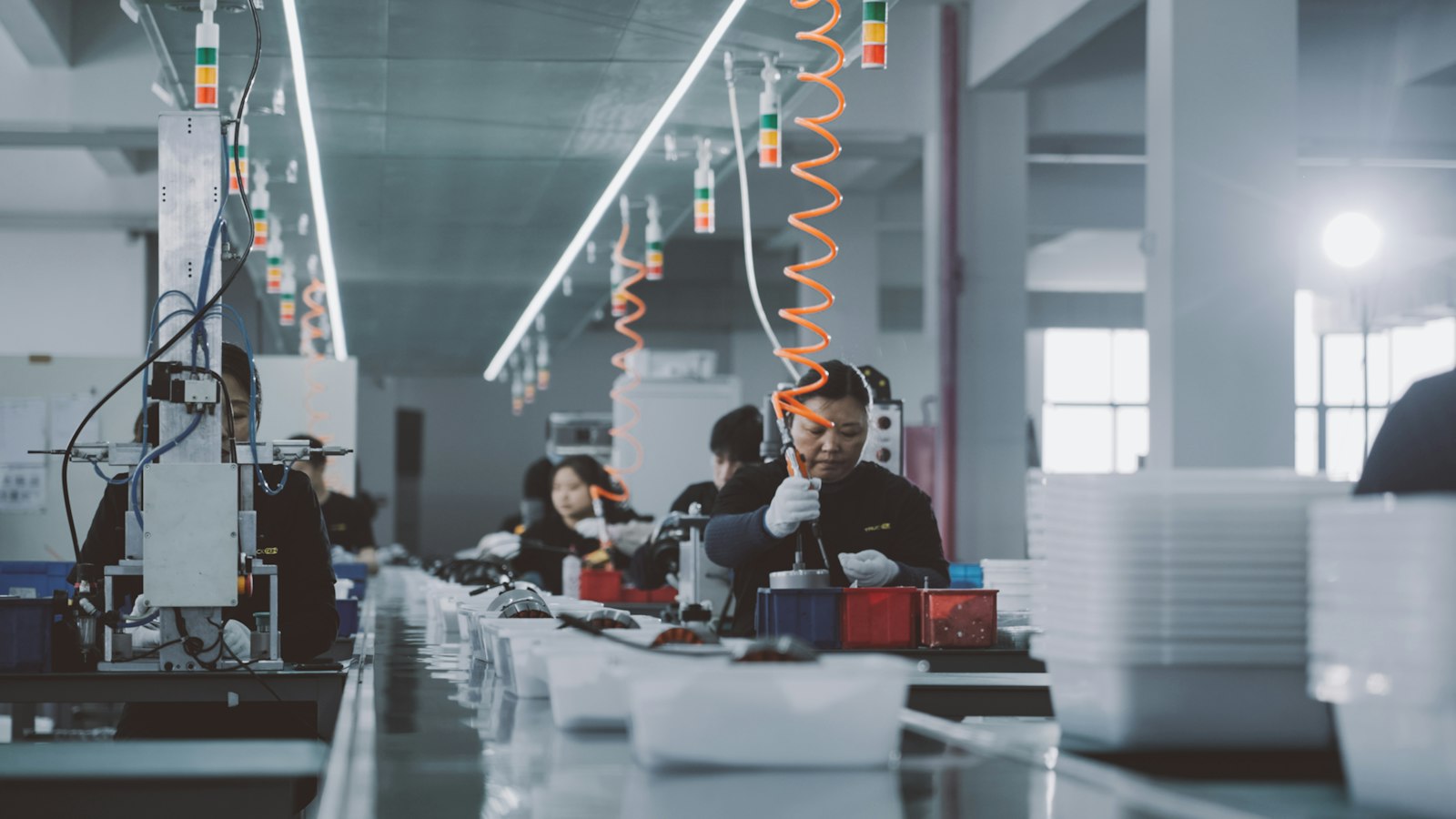
The supplier with the best price on Alibaba often calls itself a "manufacturer." Some are. Many are trading companies reselling a factory's goods with a markup, and a few are neither. Before you wire a deposit, there is one question worth settling: does this company make your product, or buy it from someone who does? This guide shows how to answer it from official Chinese records that a supplier cannot stage for a photo.
Quick answer
A Chinese supplier is a real factory when its official records line up: the business scope (经营范围) on its licence lists production verbs (生产, 制造, 加工), it holds a pollutant-discharge permit (排污许可) for a registered production site, its insured-staff count (参保人数) matches a real workforce, and its VAT input invoices show raw materials rather than finished goods. A trading company usually registers only sales and import-export terms, holds no discharge permit, and buys finished goods. The platform badge alone does not decide it — the registry does.
What "factory" and "trading company" actually mean
A factory (工厂) owns or operates production: machines, a line, workers, a site that discharges something and is permitted to. It sells what it makes.
A trading company (贸易公司 / 外贸公司) buys finished goods from factories and resells them, often to overseas buyers it can reach in English. A good trading company adds real value — quality control, consolidation, export paperwork, financing. It is not a scam. But its price carries a margin, and it stands between you and the people who control your product's quality and lead time.
Many Chinese suppliers are a combination (工贸一体): a real factory that also runs an export arm, or a trading company that has acquired a small line. The goal is not to label every supplier good or bad. It is to know which role the company in front of you plays, so you negotiate, audit and pay the right entity.
How to tell them apart, step by step
You can do most of this yourself before you ever ask the supplier a question.
- Get the legal name and the 18-character USCC. Ask the supplier for its Unified Social Credit Code (统一社会信用代码), or read it off the business licence it sends. Decode it with the free USCC decoder to confirm the entity type and registration region.
- Read the business scope (经营范围). On the licence, the scope lists what the company is registered to do. Production verbs — 生产 (produce), 制造 (manufacture), 加工 (process) — point to a maker; 销售 (sell), 批发 (wholesale), 进出口 (import-export) point to trade. Paste a scope into the free business scope checker to see the split. For the full method, see how to read a Chinese business license to tell factory from trader.
- Look beyond the scope. The scope is self-declared, so it shows intent, not proof. Confirm a maker with records only a factory leaves: a discharge permit, an insured workforce, production-type purchases. These are the 5 official records that prove a supplier is a real factory.
- Match the entity everywhere. Check that the same name and USCC appear on the pro forma invoice, the contract and the bank account you pay. A mismatch means you are contracting with one company and paying another.
The records that settle it (information most buyers never check)
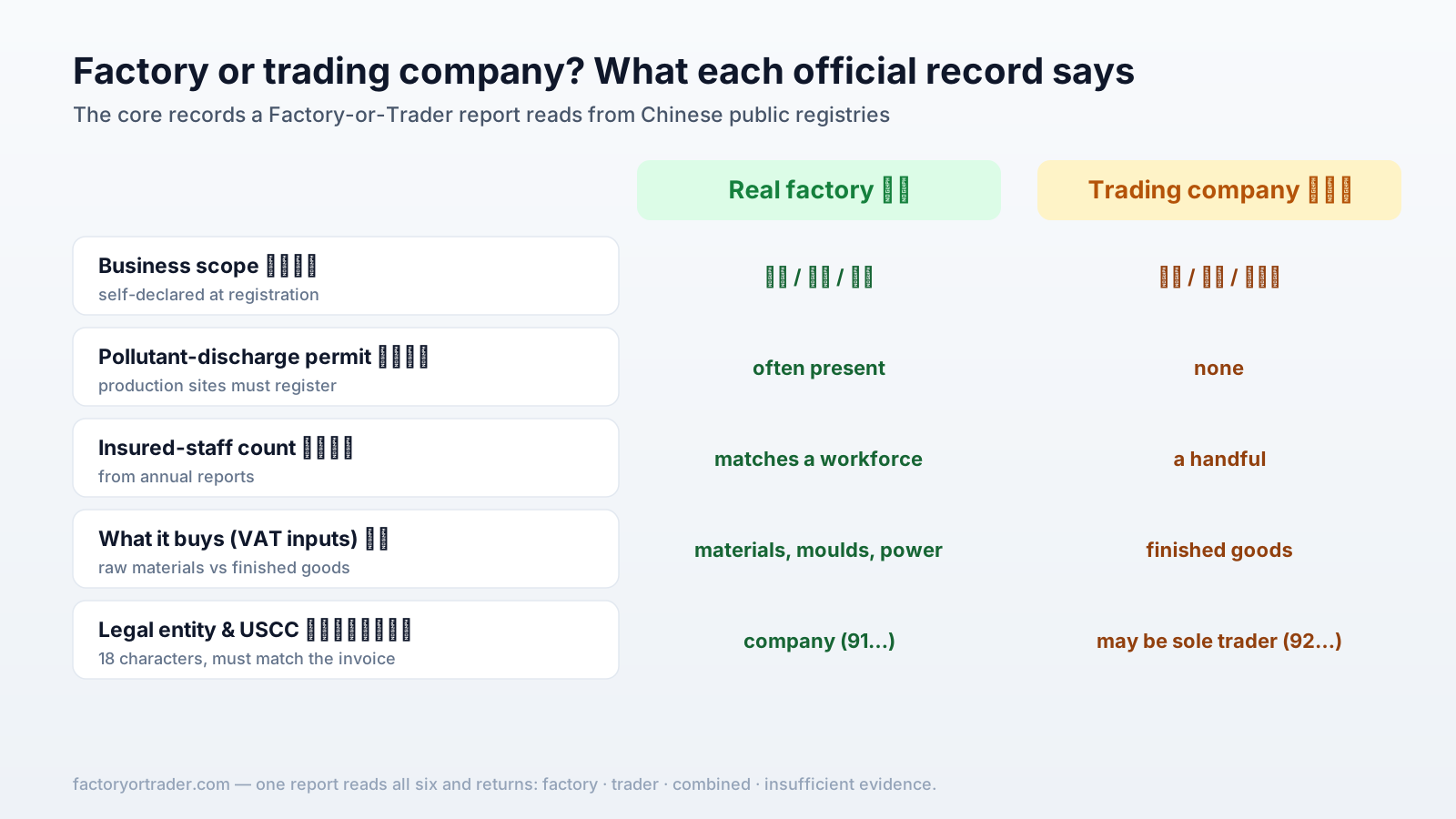
Every company in mainland China files records with the authorities and the public National Enterprise Credit Information Publicity System (国家企业信用信息公示系统, GSXT). Read together, these separate makers from resellers:
- Business scope (经营范围) — production terms vs sales and import-export terms.
- Pollutant-discharge permit (排污许可) — production sites register with the national discharge platform, naming the site and its industry. In our test set of confirmed factories, 63% held one; pure traders hold none.
- Insured-staff count (参保人数) — annual reports list how many employees the company pays social insurance for. A profile claiming "200 workers" against 4 insured staff is worth a question.
- What it buys (VAT input invoices) — a factory's inputs are raw materials, moulds, packaging and an electricity bill; a trading company's inputs are finished goods, often from the factory you actually want.
- Court and litigation records (涉诉记录) — cases, enforcement and dishonest-debtor listings are a supplier-risk signal separate from the factory question.
- Legal entity and USCC — the entity you are really dealing with, and the code that must match your invoice.
This is the part platform badges cannot show you, and it is what a Factory or Trader report reads automatically from the registry, permit, court and invoice records.
Where the simple rules break (read this before you judge)
The split above is a starting point, not a verdict. Three honest caveats:
- Factories list 销售 too. Almost every manufacturer registers "sales of its own products," and many run a separate export entity (工贸分离). Seeing 销售 in the scope does not make a company a trader — weigh it against the permit, staff and purchase records.
- An individual business (个体工商户) is not automatically a red flag. A USCC beginning with 92 marks a sole proprietor rather than a company. Plenty are legitimate small workshops. It changes who signs and how you contract, not whether the goods are good.
- "Verified Supplier" is a real signal. Alibaba's Verified check sends an inspector to a site, and the report is useful — read it for what it actually says. The point is to add the registry records on top, not to dismiss the badge.
FAQ
How can I tell if an Alibaba supplier is a factory or a trading company? Read the official records, not the profile. Check the business scope on the licence for production terms, confirm a pollutant-discharge permit and an insured workforce, and see whether its purchases are raw materials or finished goods. The business scope checker and a Factory or Trader report do this from the registry.
Both of my suppliers say they are the factory. How do I know which one is? Compare their records side by side. The real maker will have a discharge permit for a production site, an insured headcount that fits a workforce, and material purchases. The reseller will have none of these and will buy finished goods.
Is it bad to buy from a trading company? No. A good trading company adds quality control and export handling. Just know you are buying from one, so you can judge the margin, ask who makes the goods, and audit the real production site before a large order.
Does the Alibaba Gold Supplier or Verified badge prove it is a factory? No. Those confirm the company exists and, for Verified, that a site was inspected. Neither tells you whether this company makes your product. See what Alibaba supplier verification actually checks.
Settle it before you pay
You can do the first pass yourself: decode the USCC, read the business scope, and ask for the records above. When you want one answer across all of them, a Factory or Trader report reads the registry, permit, court and VAT invoice records and returns a verdict — factory, trading company, combined, or insufficient evidence — and, when the supplier is a trader, the factories it most likely buys from.