The 5 Official Records That Prove a Supplier Is a Real Factory
Business scope, pollutant-discharge permit, insured-staff count, court records and the USCC — the five Chinese official records that separate a real factory from a trading company.

A supplier can send you a factory video, a line of workers and a wall of certificates, and still be a trading company reselling someone else's goods. What it cannot stage is the paper trail every mainland-China company leaves with the authorities. Here are the five official records that actually prove a supplier makes what it sells — and where each one comes from.
Quick answer
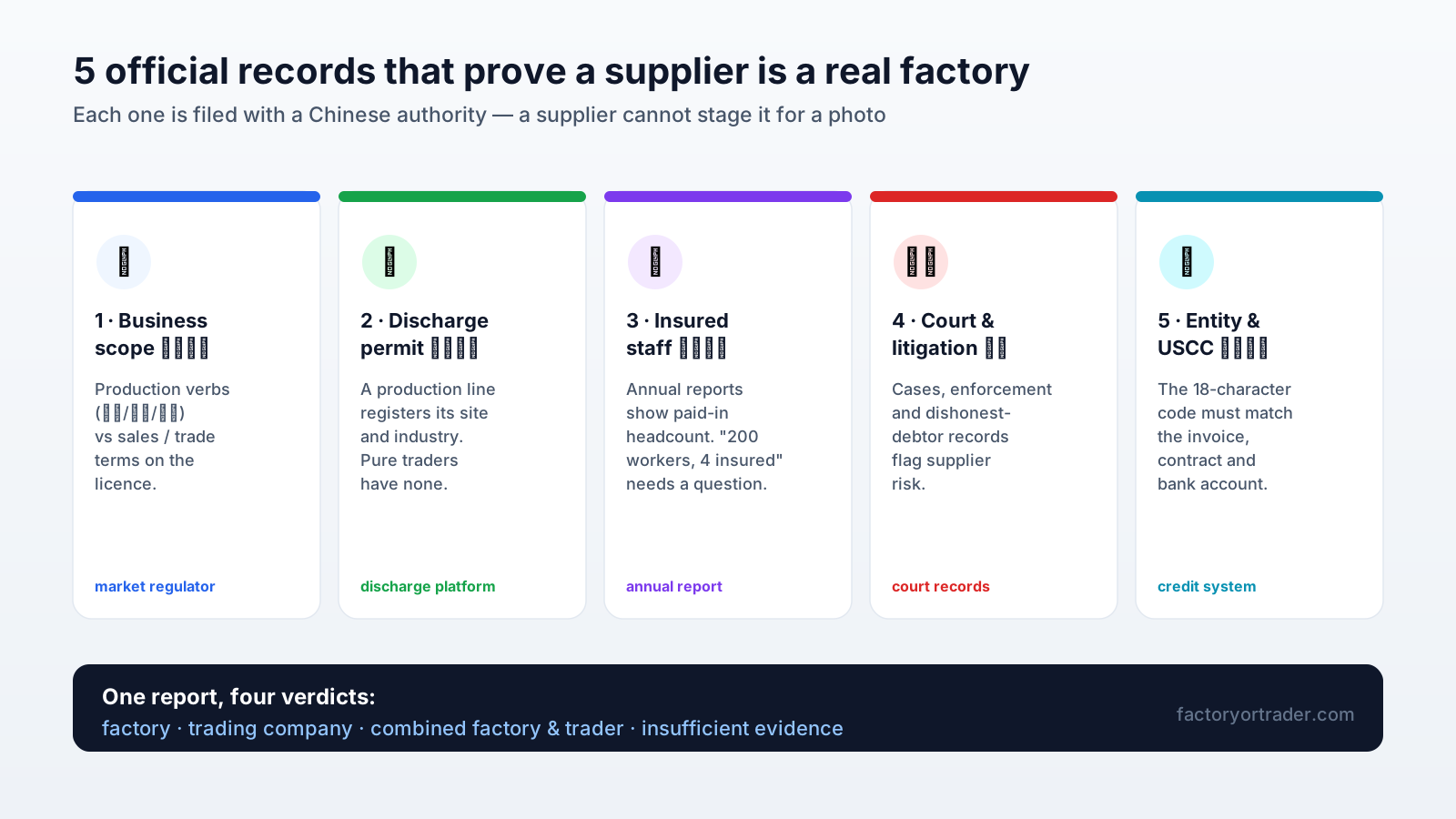
Five records settle whether a Chinese supplier is a real factory: the business scope (经营范围) on its licence, a pollutant-discharge permit (排污许可) for a registered production site, an insured-staff count (参保人数) that fits a workforce, court and litigation records (涉诉记录) for risk, and the legal entity and USCC that must match your invoice. A real factory shows production terms, a permit and an insured workforce; a trader shows none of these.
The five records, and what each one tells you
1. Business scope (经营范围)
Filed with the market regulator and printed on the business licence, the scope lists what the company is registered to do. Production verbs — 生产, 制造, 加工 — point to a maker; 销售, 批发, 进出口 point to trade. It is the fastest first read, and you can do it yourself: see how to read a Chinese business license, or paste a scope into the free business scope checker. The scope shows intent, so treat it as the opening signal, not the verdict.
2. Pollutant-discharge permit (排污许可)
A company that runs production lines registers with the national pollutant-discharge system, which records the site and its industry — for example "metal tool manufacturing." A pure trading company has no production site and holds no such permit. In our test set of confirmed factories, 63% held a discharge permit or registration; traders held none. A permit tied to a site in your product's industry is one of the strongest "this is a maker" signals available without visiting.
3. Insured-staff count (参保人数)
Chinese companies file annual reports that include the number of employees they pay social insurance for. This is hard to inflate, because it is tied to real payroll. A supplier claiming "200 workers" against 4 insured staff is either outsourcing production or exaggerating its scale — worth a direct question before a large order. A factory's insured count broadly fits the workforce its line would need.
4. Court and litigation records (涉诉记录)
Public records show civil cases, enforcement actions, dishonest-debtor listings (失信被执行人) and consumption-restriction orders. These do not answer the factory question directly, but they answer a question that matters just as much: is this a supplier you want to prepay? A maker with a clean record and a trader buried in enforcement cases are different risks at the same price.
5. Legal entity and USCC (统一社会信用代码)
The 18-character Unified Social Credit Code identifies the one legal entity you are actually dealing with. Decode it with the free USCC decoder, then confirm the same name and code appear on the pro forma invoice, the contract and the bank account you pay. A code beginning with 92 marks an individual business (个体工商户) rather than a company — common and often fine, but it changes who signs. The entity that makes the goods and the entity that takes your money should be traceable to each other.
How the five fit together
No single record is a verdict. A factory lists 销售 in its scope; a legitimate trader has a clean court record; a real workshop can be a sole proprietor. The signal is in the combination: production terms and a discharge permit and an insured workforce and material purchases point to a maker; a scope of pure sales with no permit, a handful of insured staff and finished-goods purchases point to a reseller. This is exactly the question of whether your supplier is a factory or a trading company, read across every record at once.
FAQ
What official records prove a Chinese supplier is a real factory? The business scope on its licence, a pollutant-discharge permit for a registered production site, an insured-staff count that fits a workforce, a clean court and litigation history, and a legal entity whose USCC matches your invoice.
How do I check if a supplier has a pollutant-discharge permit? Production sites register on China's national pollutant-discharge platform with their site and industry. A Factory or Trader report reads this automatically; without it, a missing permit for a company that claims to manufacture is a reason to ask more.
Why does insured-staff count matter more than the photos? Photos and videos can be borrowed or staged. The insured headcount is tied to real payroll in annual filings, so it is a far better proxy for whether the company employs a workforce that could make your order.
Do I need all five to decide? You need enough that agree. One record can mislead; the five together rarely do. A report weighs them into a single verdict so you are not guessing from one signal.
Read all five in one report
You can pull several of these yourself — the business scope and the USCC are free to check. When you want all five read together and weighed into one answer, a Factory or Trader report reads the registry, permit, court and VAT invoice records and returns a verdict — factory, trading company, combined, or insufficient evidence — plus, when the supplier is a trader, the factories it most likely buys from.