Permits & licenses
Which products need China’s industrial production license? A primary-source applicability table
- Published
- Nov 26, 2026
- Updated
- Nov 26, 2026
- Version
- 1.0
- Reviewed by
- Factory or Trader Research, Nov 26, 2026

China’s industrial product production license covers a short catalogue of product types set by the State Council; products outside the catalogue are not under it. Food, cosmetics and medical devices have production licenses of their own, which this note does not cover. The pollutant-discharge permit list is a separate system that sorts manufacturing sites by industry into key, simplified and registration tiers. This note tabulates both from the official texts and treats them as two independent checks.
Suppliers often send buyers a "production license" as proof that they make what they sell. This note covers one specific license: China's industrial product production license. It applies only to the product types the State Council lists in a catalogue [1]. Several other goods have production licenses of their own under separate rules, among them food [14], cosmetics [15] and Class II and III medical devices [16]. Those regimes are not covered here.
This note sets out, from the official documents themselves, which product types the industrial license covers today, and how the separate pollutant-discharge permit system sorts manufacturing sites. The two systems answer different questions about a supplier, so they are two independent checks (Figure 1). Both tables can be downloaded below.
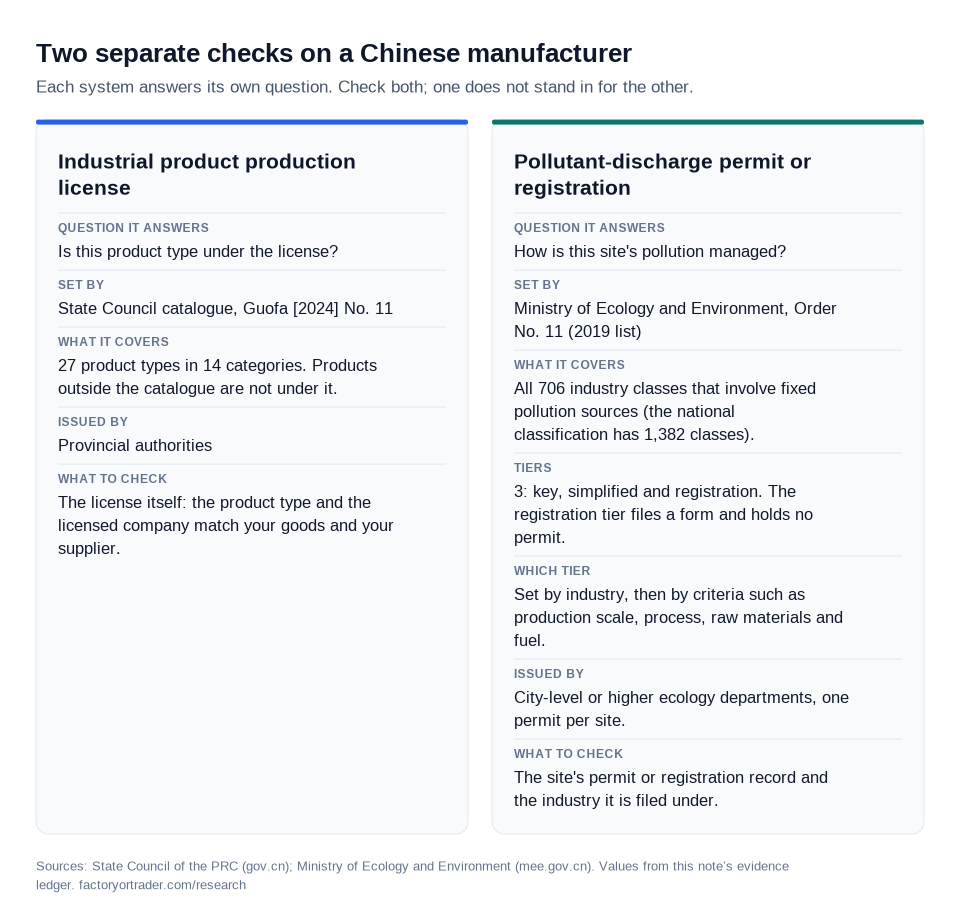
The production license catalogue
The current catalogue comes from State Council document Guofa [2024] No. 11, signed on 2024-05-03 and published on 2024-05-09 [1]. After that decision, the license covers 27 product types in 14 categories [1]. Licenses are issued by provincial authorities, and the approval power may not be delegated further down [1].
The decision added 6 product types: cold-rolled ribbed steel bars, regulators for bottled liquefied petroleum gas, steel wire rope, plywood, blockboard and safety helmets. Licensing of these was to start before the end of September 2024 [1]. It also moved fertilizer approval to review before license [1].
The catalogue is published as an image (Figure 2). Our transcription and translation follow it.
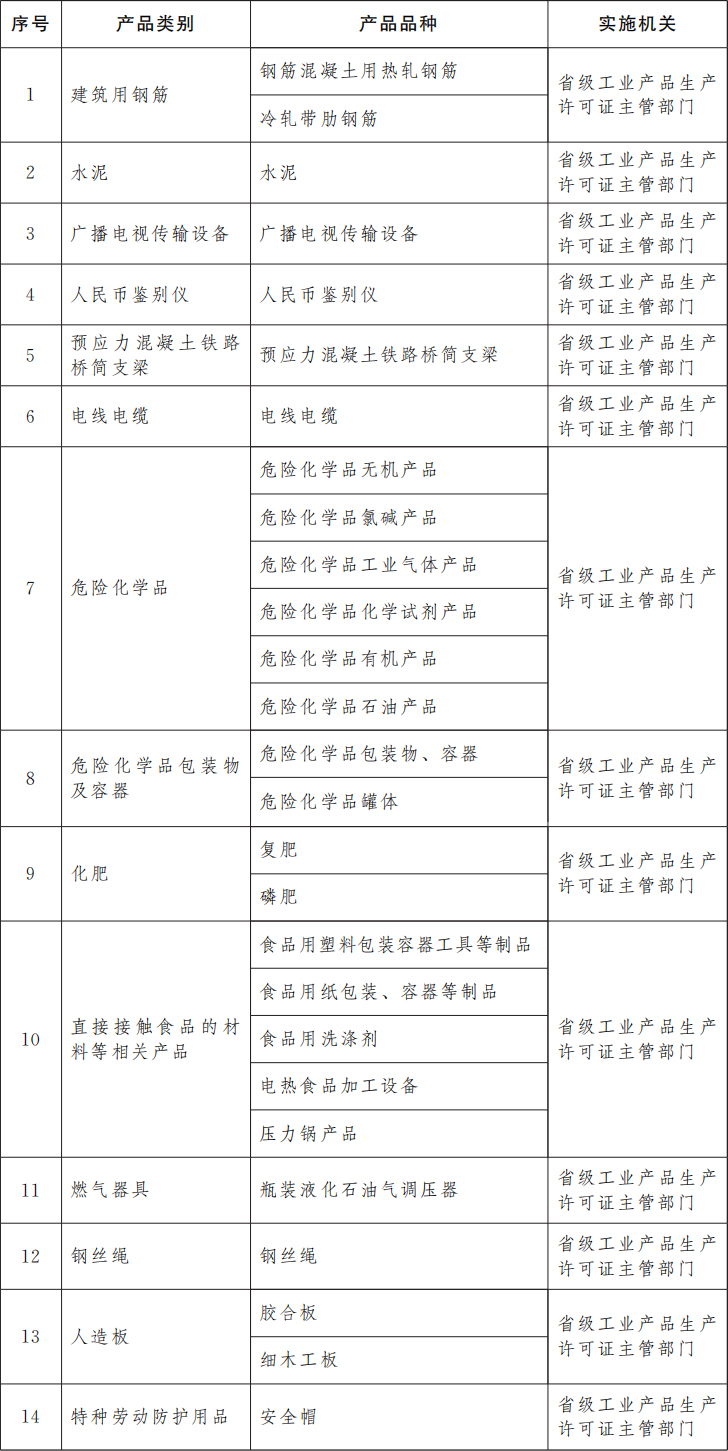
| Category no | Category en | Product type en | Product type zh | Added in 2024 |
|---|---|---|---|---|
| 1 | Steel bars for construction | Hot-rolled steel bars for reinforced concrete | 钢筋混凝土用热轧钢筋 | no |
| 1 | Steel bars for construction | Cold-rolled ribbed steel bars | 冷轧带肋钢筋 | yes |
| 2 | Cement | Cement | 水泥 | no |
| 3 | Radio and television transmission equipment | Radio and television transmission equipment | 广播电视传输设备 | no |
| 4 | RMB banknote authentication devices | RMB banknote authentication devices | 人民币鉴别仪 | no |
| 5 | Prestressed concrete simply supported railway bridge beams | Prestressed concrete simply supported railway bridge beams | 预应力混凝土铁路桥简支梁 | no |
| 6 | Electric wires and cables | Electric wires and cables | 电线电缆 | no |
| 7 | Hazardous chemicals | Hazardous chemicals: inorganic products | 危险化学品无机产品 | no |
| 7 | Hazardous chemicals | Hazardous chemicals: chlor-alkali products | 危险化学品氯碱产品 | no |
| 7 | Hazardous chemicals | Hazardous chemicals: industrial gases | 危险化学品工业气体产品 | no |
| 7 | Hazardous chemicals | Hazardous chemicals: chemical reagents | 危险化学品化学试剂产品 | no |
| 7 | Hazardous chemicals | Hazardous chemicals: organic products | 危险化学品有机产品 | no |
| 7 | Hazardous chemicals | Hazardous chemicals: petroleum products | 危险化学品石油产品 | no |
| 8 | Packaging and containers for hazardous chemicals | Packaging and containers for hazardous chemicals | 危险化学品包装物、容器 | no |
| 8 | Packaging and containers for hazardous chemicals | Tanks for hazardous chemicals | 危险化学品罐体 | no |
| 9 | Fertilizers | Compound fertilizers | 复肥 | no |
| 9 | Fertilizers | Phosphate fertilizers | 磷肥 | no |
| 10 | Food-contact materials and related products | Plastic packaging, containers, utensils and similar articles for food | 食品用塑料包装容器工具等制品 | no |
| 10 | Food-contact materials and related products | Paper packaging, containers and similar articles for food | 食品用纸包装、容器等制品 | no |
| 10 | Food-contact materials and related products | Detergents for food use | 食品用洗涤剂 | no |
| 10 | Food-contact materials and related products | Electrically heated food-processing equipment | 电热食品加工设备 | no |
| 10 | Food-contact materials and related products | Pressure cookers | 压力锅产品 | no |
| 11 | Gas appliances | Regulators for bottled liquefied petroleum gas | 瓶装液化石油气调压器 | yes |
| 12 | Steel wire rope | Steel wire rope | 钢丝绳 | yes |
| 13 | Wood-based panels | Plywood | 胶合板 | yes |
| 13 | Wood-based panels | Blockboard | 细木工板 | yes |
| 14 | Special labor protection articles | Safety helmets | 安全帽 | yes |
What this means for a buyer
- The license applies to the catalogue only. Products outside the listed types are not under this license regime [1]. For those products a factory has no industrial production license to show, and that is expected. Judge by what the factory actually makes, not by its trade: a furniture maker that also produces plywood makes a listed product type [1].
- Food-contact goods are one listed category. It holds 5 product types: plastic food packaging and utensils, paper food packaging, detergents for food use, electrically heated food-processing equipment and pressure cookers [2].
- Check the product type, not the category name. A supplier of chemicals, cables or wood panels should hold a license only for the specific listed product types it makes.
The pollutant-discharge permit list
Pollutant-discharge permits follow a different rulebook: the classification list issued as Ministry of Ecology and Environment Order No. 11 on 2019-12-20 [3]. It sorts dischargers into 3 tiers: key management, simplified management and registration management [3]. Sites in the registration tier hold no permit: they file a registration form on the national permit platform instead [3]. Which tier a site falls in depends on its industry and, within an industry, on criteria such as production scale, process, raw-material use and fuel type [6].
The list follows the national industry classification GB/T 4754-2017 [3]. Its table has 112 rows: 108 industry categories and 4 general processes (boilers, industrial kilns, surface treatment and water treatment) [3]. According to the ministry, the industry categories span 49 divisions, 212 groups and 706 classes, which is every one of the 1,382 classes in the national classification that involves fixed pollution sources [6].
Permits are issued site by site, by the ecology department of the city-level (or higher) government where the site is located [13], and permit holders publish their discharge information on the national permit platform [13].
| Section no | Section en | Gbt4754 division code | List row first | List row last | List row count |
|---|---|---|---|---|---|
| 1 | Animal husbandry | 03 | 1 | 2 | 2 |
| 2 | Coal mining and washing | 06 | 3 | 3 | 1 |
| 3 | Oil and natural gas extraction | 07 | 4 | 4 | 1 |
| 4 | Ferrous metal ore mining and dressing | 08 | 5 | 5 | 1 |
| 5 | Non-ferrous metal ore mining and dressing | 09 | 6 | 6 | 1 |
| 6 | Non-metallic mineral mining and dressing | 10 | 7 | 7 | 1 |
| 7 | Other mining | 12 | 8 | 8 | 1 |
| 8 | Agricultural and sideline food processing | 13 | 9 | 16 | 8 |
| 9 | Food manufacturing | 14 | 17 | 20 | 4 |
| 10 | Liquor, beverage and refined tea manufacturing | 15 | 21 | 23 | 3 |
| 11 | Tobacco products | 16 | 24 | 24 | 1 |
| 12 | Textiles | 17 | 25 | 26 | 2 |
| 13 | Textile garments and apparel | 18 | 27 | 28 | 2 |
| 14 | Leather, fur, feather and related products, and footwear | 19 | 29 | 32 | 4 |
| 15 | Wood processing and wood, bamboo, rattan, palm and straw products | 20 | 33 | 34 | 2 |
| 16 | Furniture manufacturing | 21 | 35 | 35 | 1 |
| 17 | Paper and paper products | 22 | 36 | 38 | 3 |
| 18 | Printing and reproduction of recording media | 23 | 39 | 40 | 2 |
| 19 | Culture, education, arts and crafts, sports and entertainment goods | 24 | 41 | 41 | 1 |
| 20 | Petroleum, coal and other fuel processing | 25 | 42 | 44 | 3 |
| 21 | Chemical raw materials and chemical products | 26 | 45 | 52 | 8 |
| 22 | Pharmaceutical manufacturing | 27 | 53 | 59 | 7 |
| 23 | Chemical fibers | 28 | 60 | 60 | 1 |
| 24 | Rubber and plastic products | 29 | 61 | 62 | 2 |
| 25 | Non-metallic mineral products | 30 | 63 | 70 | 8 |
| 26 | Ferrous metal smelting and rolling | 31 | 71 | 74 | 4 |
| 27 | Non-ferrous metal smelting and rolling | 32 | 75 | 79 | 5 |
| 28 | Metal products | 33 | 80 | 82 | 3 |
| 29 | General-purpose equipment | 34 | 83 | 83 | 1 |
| 30 | Special-purpose equipment | 35 | 84 | 84 | 1 |
| 31 | Automobile manufacturing | 36 | 85 | 85 | 1 |
| 32 | Railway, ship, aerospace and other transport equipment | 37 | 86 | 86 | 1 |
| 33 | Electrical machinery and equipment | 38 | 87 | 88 | 2 |
| 34 | Computers, communication and other electronic equipment | 39 | 89 | 90 | 2 |
| 35 | Instruments and meters | 40 | 91 | 91 | 1 |
| 36 | Other manufacturing | 41 | 92 | 92 | 1 |
| 37 | Comprehensive utilization of waste resources | 42 | 93 | 93 | 1 |
| 38 | Repair of metal products, machinery and equipment | 43 | 94 | 94 | 1 |
| 39 | Electricity and heat production and supply | 44 | 95 | 96 | 2 |
| 40 | Gas production and supply | 45 | 97 | 97 | 1 |
| 41 | Water production and supply | 46 | 98 | 99 | 2 |
| 42 | Retail trade | 52 | 100 | 100 | 1 |
| 43 | Water transport | 55 | 101 | 101 | 1 |
| 44 | Loading, unloading and warehousing | 59 | 102 | 102 | 1 |
| 45 | Ecological protection and environmental management | 77 | 103 | 103 | 1 |
| 46 | Public facilities management | 78 | 104 | 104 | 1 |
| 47 | Resident services | 80 | 105 | 105 | 1 |
| 48 | Repair of motor vehicles, electronic products and household goods | 81 | 106 | 106 | 1 |
| 49 | Health care | 84 | 107 | 107 | 1 |
| 50 | Other industries (not listed above) | 108 | 108 | 1 | |
| 51 | General processes (boilers, industrial kilns, surface treatment, water treatment) | 109 | 112 | 4 |
A revised draft of the list was approved in principle at a ministerial meeting on 2026-10-15 [7]. When we checked the ministry rules library, the revised list was not yet listed, so this note uses the 2019 edition [8]. A September 2026 ministry order that amended and repealed a set of rules left the 2019 list in place [10].
How the two systems fit together
The production license is about what a company makes: a short list of product types. The discharge permit system is about the site where it makes things: every industry class that involves fixed pollution sources falls somewhere in the classification list, even if only in the registration tier [6], and the tier depends on the site's industry, scale, process, raw materials and fuel [6]. The two answer different questions, so check each one on its own:
- Production license. Is your product type in the catalogue? If it is, ask for the license and check that the product type and the licensed company match your goods and your supplier. If it is not, there is no industrial production license to ask for.
- Discharge permit or registration. Separately, whatever the product, look at the site's discharge permit or registration record and at the industry it is filed under [3].
One record does not stand in for the other: a license, or the lack of one, says nothing about the site's discharge record, and the discharge record says nothing about which products are licensed.
To see which of these records a specific supplier holds, run a free check.
Method and limitations
Document review. We downloaded the State Council decision and its catalogue image from gov.cn and the Ministry of Ecology and Environment classification list, its Q&A and its revision news from mee.gov.cn, kept raw copies, transcribed the catalogue by hand and parsed the list structure from the official PDF with a script. Every figure in this note is a ledger claim tied to one of those documents; counts in the tables are re-derived by the QA script before publication.
Sample frame. Official documents only: the 2024 production license catalogue and the 2019 discharge permit classification list. No company records are used. Period. Documents in force on 2026-11-26.
Limitations
- This note covers the industrial product production license and the discharge permit list only. Other production licenses (food, cosmetics, Class II and III medical devices and others), compulsory product certification (CCC) and other market-access regimes are separate and are not covered.
- The detailed scope of each product type is set in the market regulator’s implementing rules, which we did not review; read the table as the list of product types, not as a scope ruling for a specific product.
- The production license catalogue is published as an image; we transcribed it by hand. Its row and category counts match the totals stated in the decision text.
- English names of categories, product types and industry sections are our translations.
- The discharge permit table shows the list structure (sections and rows), not the tier thresholds inside each row; those depend on production scale, process and fuel and are set out row by row in the official list.
- A revised discharge permit list was approved in principle in October 2026. When it is published, this note and its dataset will be updated under a new version.
- The figures show the structure of the two systems from the official texts. They do not say which tier a given site is in or whether a given product needs a license; that needs the product’s implementing rules and the site’s own records.
How every Factory or Trader research note is built and checked: research methodology.
Download the data
Products under China’s industrial production license (2024 catalogue)
All product types in the State Council catalogue of products under industrial production license management, as adjusted by Guofa [2024] No. 11, with Chinese names as published, English translations and a flag for the product types added in 2024.
v1 · 27 rows · CC-BY-4.0 · sha256 4e2b36ad46e9175d80beac8ee687f16bbd1aa9b2d975ace363bfde1247610ff7
Columns
category_noCategory number in the official catalogue (1 to 14).category_zhCategory name as published (Chinese).category_enCategory name, our English translation.product_type_zhProduct type as published (Chinese).product_type_enProduct type, our English translation.added_in_2024yes if Guofa [2024] No. 11 brought this product type under licensing.licensing_authority_enIssuing authority named in the catalogue.claim_idLedger claim that backs this row.
Sections of China’s pollutant-discharge permit classification list (2019 edition)
The section headings of the Ministry of Ecology and Environment classification list for fixed pollution source discharge permits (Order No. 11, 2019), with the national industry division code and the numbered list rows each section covers.
v1 · 51 rows · CC-BY-4.0 · sha256 4898b0b04de42fbd088e0bb3be6fc089f4993961e3730c081c78368aab7028e8
Columns
section_noOrder of the section heading in the list table.section_zhSection heading as published (Chinese).section_enSection heading, our English translation.gbt4754_division_codeTwo-digit division code in GB/T 4754-2017; empty for the two non-division sections.list_row_firstFirst numbered row of the list under this section.list_row_lastLast numbered row of the list under this section.list_row_countNumber of list rows under this section.claim_idLedger claim that backs this row.
Sources
- State Council decision on adjusting the industrial product production license catalogue (Guofa [2024] No. 11) — State Council of the PRC (gov.cn). Retrieved Nov 26, 2026.
- Catalogue attachment: products under industrial production license management — State Council of the PRC (gov.cn). Retrieved Nov 26, 2026. Published as an image; transcribed by hand into the catalogue dataset.
- Classification list for fixed pollution source discharge permits (2019 edition), Order No. 11 — Ministry of Ecology and Environment of the PRC (mee.gov.cn). Retrieved Nov 26, 2026.
- Text layer of the Order No. 11 PDF (pdftotext -layout) and the parsed section structure — Derived from the Ministry of Ecology and Environment PDF. Retrieved Nov 26, 2026.
- Parsed sections of the 2019 list (scripts/research/parse_mee_list.py output) — Derived from the Ministry of Ecology and Environment PDF. Retrieved Nov 26, 2026.
- Ministry Q&A on the 2019 classification list — Ministry of Ecology and Environment of the PRC (mee.gov.cn). Retrieved Nov 26, 2026.
- Ministerial meeting approving a revised draft list in principle — Ministry of Ecology and Environment of the PRC (mee.gov.cn). Retrieved Nov 26, 2026.
- Ministry rules library index (first page) — Ministry of Ecology and Environment of the PRC (mee.gov.cn). Retrieved Nov 26, 2026.
- Ministry list of ministerial orders (部令), first page — Ministry of Ecology and Environment of the PRC (mee.gov.cn). Retrieved Nov 26, 2026.
- Decision on amending and repealing certain rules (Order No. 39) — Ministry of Ecology and Environment of the PRC (mee.gov.cn). Retrieved Nov 26, 2026.
- Order No. 39, annex 1: rules amended — Ministry of Ecology and Environment of the PRC (mee.gov.cn). Retrieved Nov 26, 2026.
- Order No. 39, annex 2: rules repealed — Ministry of Ecology and Environment of the PRC (mee.gov.cn). Retrieved Nov 26, 2026.
- Regulation on the Administration of Pollutant Discharge Permits (State Council Order No. 736) — State Council of the PRC, as published by the Ministry of Ecology and Environment (mee.gov.cn). Retrieved Nov 26, 2026.
- Measures for the Administration of Food Production Licensing (SAMR Order No. 24) — State Council Gazette (gov.cn). Retrieved Nov 26, 2026.
- Regulation on the Supervision and Administration of Cosmetics (State Council Order No. 727) — State Council of the PRC (gov.cn). Retrieved Nov 26, 2026.
- Regulation on the Supervision and Administration of Medical Devices (State Council Order No. 739) — State Council of the PRC (gov.cn). Retrieved Nov 26, 2026.
Evidence ledger
Every figure on this page is one of these claims. Each names its official source and how we read it.
| Claim | Value | Statement | Source | Method |
|---|---|---|---|---|
| lic-doc | Guofa [2024] No. 11 | Document number of the State Council decision that adjusts the industrial product production license catalogue (国发〔2024〕11号). | [1] 2026-11-26 | Read on the official gov.cn page (发文字号). |
| lic-issued | 2024-05-03 | Date the decision was signed (成文日期). | [1] 2026-11-26 | Read on the official gov.cn page. |
| lic-published | 2024-05-09 | Date the decision was published on gov.cn (发布日期). | [1] 2026-11-26 | Read on the official gov.cn page. |
| lic-categories | 14 | After the adjustment, the industrial production license covers products in 14 categories (共计14类). | [1] 2026-11-26 | Quoted from the decision text; re-derived as distinct category_no in the catalogue dataset. |
| lic-types | 27 | After the adjustment, the industrial production license covers 27 product types (27个品种). | [1] 2026-11-26 | Quoted from the decision text; re-derived as the row count of the catalogue dataset. |
| lic-added | 6 | The decision adds 6 product types: cold-rolled ribbed steel bars, regulators for bottled LPG, steel wire rope, plywood, blockboard and safety helmets. | [1] 2026-11-26 | Quoted from the decision text; re-derived as rows with added_in_2024 = yes. |
| lic-start | end of September 2024 | Licensing of the 6 added product types was to start before the end of September 2024 (确保于2024年9月底前开始实施). | [1] 2026-11-26 | Quoted from the decision text. |
| lic-authority | provincial authorities | Licenses are issued by provincial-level industrial product production license authorities, and the approval power may not be delegated further down. | [1] 2026-11-26 | Quoted from the decision text and the catalogue column 实施机关. |
| lic-fertilizer | review before license | Fertilizer license approval changed from notification-and-commitment to review before the license is issued (先核后证). | [1] 2026-11-26 | Quoted from the decision text. |
| lic-scope | catalogue only | The industrial production license applies to the product types listed in the catalogue; products outside the 27 listed types are not under this license regime. | [1] 2026-11-26 | Reading of the decision: licensing applies to the catalogue (实施工业产品生产许可证管理的产品目录). |
| lic-catalogue | 27 | The catalogue attachment (实施工业产品生产许可证管理的产品目录), published as an image on gov.cn, transcribed row by row. | [2] 2026-11-26 | Manual transcription of the official catalogue image; English names are our translation. Row count and category count match the totals stated in the decision text. |
| lic-food-types | 5 | Category 10 (food-contact materials and related products) contains 5 product types. | [2] 2026-11-26 | Counted from the transcribed catalogue (rows with category_no = 10). |
| mee-order | Order No. 11 | The classification list for pollutant discharge permits (2019 edition) was issued as Ministry of Ecology and Environment Order No. 11 (生态环境部令第11号). | [3] 2026-11-26 | Read on the official PDF of the rule. |
| mee-order-date | 2019-12-20 | Date the 2019 classification list was issued; it took effect on issue. | [3] 2026-11-26 | Read on the official PDF of the rule. |
| mee-tiers | 3 | The list sorts dischargers into three management tiers: key management, simplified management and registration management (Article 2). | [3] 2026-11-26 | Quoted from Article 2. |
| mee-registration | no permit | Units under registration management do not apply for a permit; they file a discharge registration form on the national pollutant discharge permit platform (Article 2). | [3] 2026-11-26 | Quoted from Article 2. |
| mee-classification-std | GB/T 4754-2017 | Industries in the list follow the national industry classification GB/T 4754-2017 (Article 3). | [3] 2026-11-26 | Quoted from Article 3. |
| mee-rows | 112 | The list table has 112 numbered rows. | [3] 2026-11-26 | Parsed from the official PDF text (scripts/research/parse_mee_list.py; rows 1 to 112 found in sequence); matches Articles 6 and 7, which refer to rows 1-107, 108 and 109-112. |
| mee-industry-categories | 108 | The 2019 list contains 108 industry categories. | [6] 2026-11-26 | Quoted from the official Q&A; consistent with rows 1 to 108 of the list. |
| mee-general-processes | 4 | Rows 109 to 112 are four general processes: boilers, industrial kilns, surface treatment and water treatment. | [3] 2026-11-26 | Quoted from Article 6 and the list table. |
| mee-divisions | 49 | The 108 industry categories span 49 divisions (大类) of the national industry classification. | [6] 2026-11-26 | Quoted from the official Q&A; re-derived as sections with a division code in the sections dataset. |
| mee-groups | 212 | The 108 industry categories span 212 groups (中类). | [6] 2026-11-26 | Quoted from the official Q&A. |
| mee-classes | 706 | The list covers 706 classes (小类) of the national industry classification: all classes that involve fixed pollution sources. | [6] 2026-11-26 | Quoted from the official Q&A. |
| nic-classes | 1,382 | The national industry classification has 1,382 classes (小类) in total. | [6] 2026-11-26 | Quoted from the official Q&A. |
| mee-list-structure | 51 | The list table is organised under 51 headed sections: 49 industry divisions, other industries and general processes. | [3] 2026-11-26 | Parsed from the official PDF text with scripts/research/parse_mee_list.py; English section names are our translation. |
| mee-revision-meeting | 2026-10-15 | A ministerial meeting approved in principle a revised draft of the classification list on 2026-10-15. | [7] 2026-11-26 | Read on the official page. |
| mee-revision-status | not yet listed | On 2026-11-26 the ministry rules library and its list of ministerial orders showed rules up to 2026-11-20 (the 2027 environmental impact assessment list) and no revised discharge permit classification list, so this article uses the 2019 edition. | [8] 2026-11-26 | Read on the official rules library index and the ministerial orders list (sources/mee-orders-list-2026-11-26.html); the index was fetched again later the same day and was byte-identical. To be re-checked on the sign-off day. |
| mee-tier-factors | industry, scale, process, raw materials and fuel | The 2019 list sorts dischargers by industry and sets the tier within an industry by criteria such as production scale, process characteristics, raw-material use and fuel type (生产规模、工艺特征、原料使用量、燃料类型等管理类别的界定标准). | [6] 2026-11-26 | Quoted from the official Q&A (answer on the overall approach of the 2019 revision). |
| mee-issuer | city-level or higher ecology departments | A discharger applies for its permit to the ecological-environment department of the local government, at the level of a city divided into districts or higher, where its site is located; a unit with several sites applies for each site separately (Article 6). | [13] 2026-11-26 | Quoted from Article 6 of the regulation. |
| mee-platform | national permit platform | Permit holders must publish their pollutant discharge information on the national pollutant discharge permit information platform (Article 23). | [13] 2026-11-26 | Quoted from Article 23 of the regulation. |
| mee-order-11-unamended | not amended or repealed | Ministry Order No. 39 (signed 2026-09-20), which amended 11 rules and repealed 17 to align them with the Ecological Environment Code, lists neither an amendment nor a repeal of the 2019 classification list (Order No. 11). | [10] 2026-11-26 | Read the decision page and both annex PDFs (sources/mee-order-39-annex-1-amended-rules.pdf, sources/mee-order-39-annex-2-repealed-rules.pdf); Order No. 11 appears in neither list. |
| other-food-license | separate regime | Food production requires a food production license under the market regulator's Measures for the Administration of Food Production Licensing (SAMR Order No. 24, Article 2), a regime separate from the industrial product production license. | [14] 2026-11-26 | Quoted from Article 2 as published in the State Council Gazette. |
| other-cosmetics-license | separate regime | Cosmetics production requires a cosmetics production license from the provincial drug regulator under the Regulation on the Supervision and Administration of Cosmetics (State Council Order No. 727, Article 27). | [15] 2026-11-26 | Quoted from Article 27 on the official gov.cn page. |
| other-device-license | separate regime | Production of Class II and Class III medical devices requires a production license from the provincial drug regulator under the Regulation on the Supervision and Administration of Medical Devices (State Council Order No. 739, Article 32). | [16] 2026-11-26 | Quoted from Article 32 on the official gov.cn page. |
Cite this research
Factory or Trader. (2026, November 26). Which products need China’s industrial production license? A primary-source applicability table (Version 1.0). https://factoryortrader.com/research/china-production-license-products
Data are free to reuse under CC-BY-4.0 with attribution to Factory or Trader and a link to this page.
Changelog and corrections
- Nov 26, 2026 (v0.1): Draft built from the official documents; scope narrowed to the industrial product production license, buyer guidance rewritten as two independent checks, figures added; awaiting sign-off.
- Nov 26, 2026 (v1.0): Signed off and published. Discharge-permit list revision re-checked on 2026-11-26: not yet published.
All corrections across research notes: corrections log. Spotted an error? Write to team@factoryortrader.com.