Alibaba Scam Red Flags the Registry Records Expose
The Alibaba scam patterns that official Chinese registry records reveal before you pay — mismatched entities, borrowed licences, no production record, and litigation history.
Most Alibaba problems are not dramatic "took the money and vanished" scams — they are quieter mismatches that the official records would have flagged before the deposit left your account. Here are the red flags that Chinese registry data exposes, and how to read them.
Quick answer
The clearest Alibaba scam signals show up in official records: the legal entity you pay does not match the one on the profile or licence; the licence or USCC belongs to a different company than the name given; there is no production record (no discharge permit, a handful of insured staff) behind a "factory"; or the company carries court and dishonest-debtor records. Checking the 18-character USCC, the business scope and the litigation history before you pay catches most of these.
The red flags registry records expose
1. The entity you pay doesn't match the entity you vetted
The single most common loss: you vet "ABC Manufacturing" but the pro forma invoice, contract or bank account names a different company or an individual. Always confirm the same name and 18-character USCC appear on the profile, the licence, the contract and the bank account. Decode the code with the free USCC decoder. A code beginning with 92 is an individual business (个体工商户), not the company you thought.
2. A borrowed or mismatched licence
Scammers send a real business licence that isn't theirs. The licence is public data, so check that the registered name, USCC and business scope (经营范围) match what the supplier claims, and that the scope actually covers your product. A licence for a company in an unrelated trade is a red flag. See how to read a Chinese business license.
3. A "factory" with no production footprint
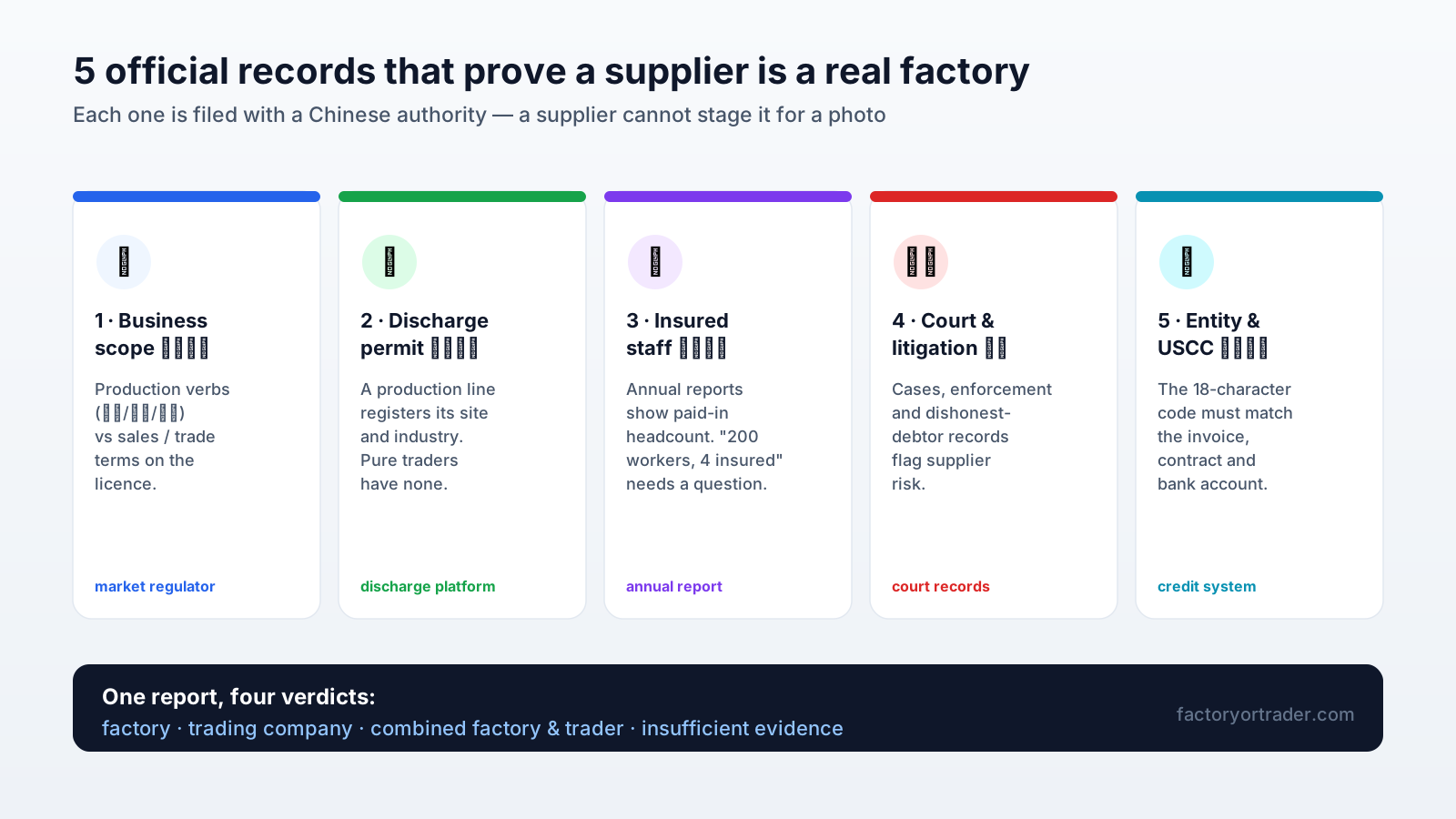
A company that calls itself a manufacturer but has no pollutant-discharge permit and only a few insured staff is, at best, not making your goods itself. These are the official records a real factory leaves — their absence behind a "factory" claim is a warning, not proof of fraud, but a reason to slow down.
4. Litigation and dishonest-debtor history
Court records, enforcement actions and dishonest-debtor (失信被执行人) listings are public. A supplier buried in unpaid-judgment cases is a different risk at the same price. This does not mean a single lawsuit is disqualifying — companies get sued — but a pattern of enforcement is a real signal.
Red flags on the page (that records then confirm)
Buyers on sourcing forums repeat the same page-level tells: prices far below everyone else, stock photos with watermarks from other brands, a brand-new profile pushing urgency, or a "manufacturer" that can supply wildly unrelated products. Treat these as prompts to pull the records above, which either confirm the worry or clear it.
What is not a red flag
Keep the false alarms in mind so you don't walk away from good suppliers:
- An individual business (个体工商户) is common and often legitimate — it changes who signs, not whether the goods are good.
- A trading company is not a scam; a good one adds real value. The risk is paying a maker's margin to a middleman unknowingly.
- Listing 销售 in the scope does not make a factory a trader — factories sell their own goods too.
FAQ
How do I avoid getting scammed on Alibaba? Verify the entity before you pay: match the USCC across profile, licence, contract and bank account; confirm the business scope covers your product; check for a production record and clean litigation history; and use Trade Assurance for the payment itself.
Can I check an Alibaba supplier's business licence is real? Yes. The registration is public. Decode the USCC and confirm the same name, code and scope appear in the official registry — a borrowed licence won't match the entity you're paying.
Is a trading company on Alibaba a scam? No. It is a legitimate reseller. The only "scam-like" risk is not knowing you're buying from one; confirm with the records whether it's a factory or a trader.
What's the fastest way to check all of this at once? A Factory or Trader report reads the registry, permit, court and VAT invoice records together and flags the mismatches above.
Check the records before the deposit
Most Alibaba losses are preventable with a five-minute records check. Decode the USCC, read the business scope, and confirm the entity you pay is the one you vetted.