1688 vs Alibaba: Which Gets You Closer to the Real Factory?
How 1688.com and Alibaba.com differ, why 1688 often sits closer to the factory, and why neither platform actually proves who makes your product.
1688.com and Alibaba.com are run by the same group, yet buyers who want factory-direct pricing keep asking which one to use. The honest answer: 1688 usually sits closer to the factory, but that is a tendency, not a guarantee — and the only thing that proves who makes your product is the company's own records.
Quick answer
1688.com is Alibaba's domestic Chinese wholesale marketplace; its sellers are often the factory or its direct agent, prices are in RMB, and the site is in Chinese. Alibaba.com is the global, English, export-facing marketplace; its sellers may be the factory or a trading company adding an export margin. 1688 tends to be closer to the maker, but a 1688 seller can still be a reseller, so confirm the factory from the business licence and USCC, not the platform.
What each platform is
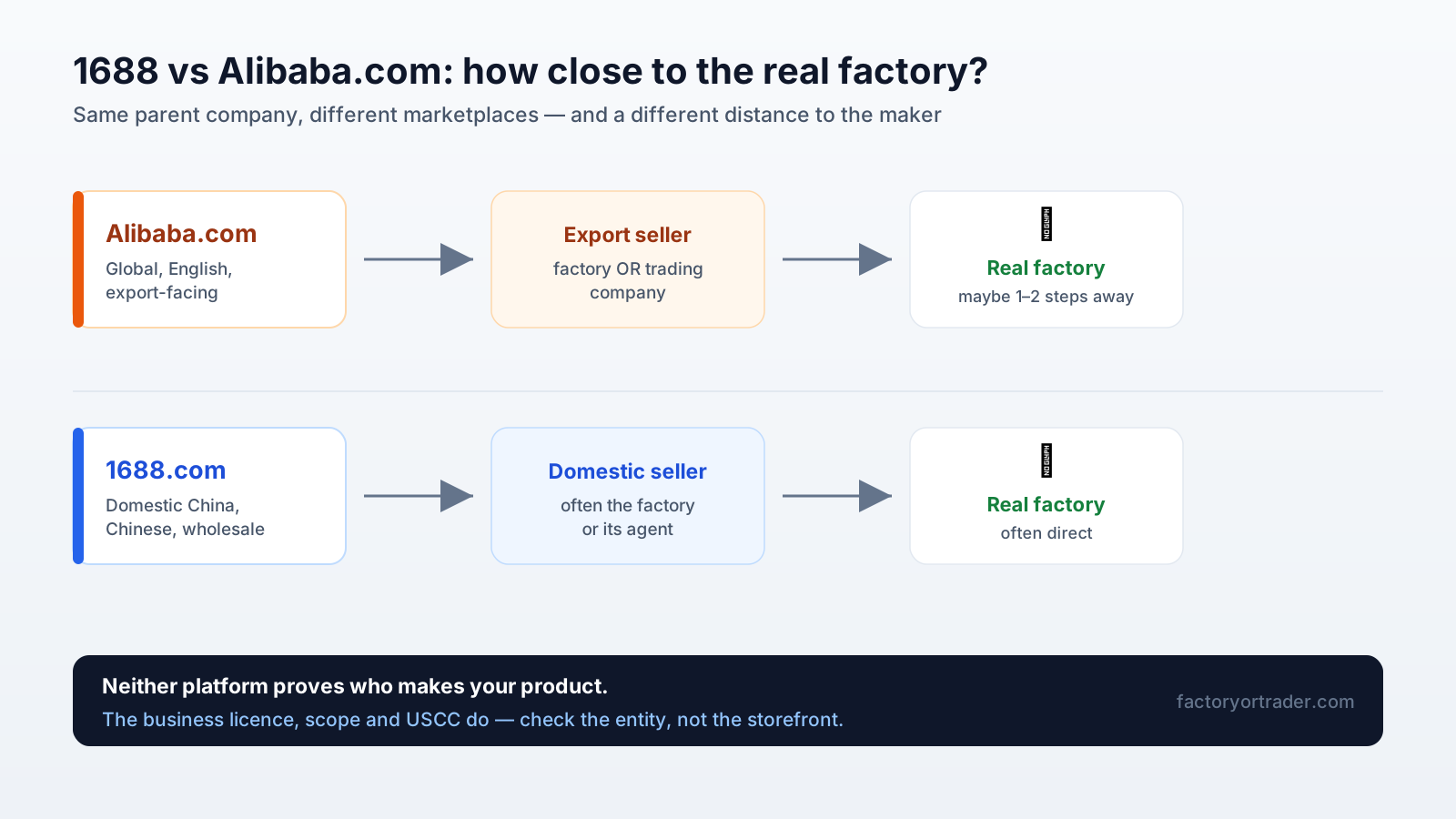
1688.com is built for buyers inside China: wholesalers, resellers and factories trading in RMB, entirely in Chinese, with low minimums and no built-in export service. Because it serves the domestic trade, many listings are the factory itself or an agent one step away.
Alibaba.com is built for the world: listings in English, export logistics, Trade Assurance and account managers who can quote in USD. That convenience is real, and some of the best factories sell here too — but the same convenience is exactly what lets a trading company sit between you and the maker, because handling export paperwork in English is a service worth paying for.
Neither is "more genuine." They serve different buyers. 1688's distance to the factory is usually shorter; Alibaba's reach and service are wider.
Why 1688 often feels closer to the factory
- Language filters the audience. A Chinese-only storefront is aimed at domestic buyers, so the seller is more often the producer than an export middleman.
- RMB pricing, no export layer. Without bundled export handling, there is less room for a trading margin to hide.
- Agents, not just resellers. Many overseas buyers reach 1688 through a sourcing agent who buys from the listed factory — the agent is your service layer, and the listing can still be the maker.
The catch: 1688 is Chinese-only, pays in RMB, and ships domestically, so most overseas buyers need an agent or forwarder to use it. And a 1688 seller can still be a pure trader. "Closer to the factory" is a probability, not proof.
What actually proves who makes your product
The storefront — on either platform — does not. The company's official records do. Whichever site you found the supplier on:
- Get the legal name and the 18-character USCC, and decode it with the free USCC decoder.
- Read the business scope (经营范围) for production verbs (生产, 制造, 加工) versus trade verbs (销售, 批发, 进出口) — see how to read a Chinese business license.
- Confirm a real maker with its permit, insured staff and purchases — the 5 official records that prove a supplier is a real factory.
That is the same method whether the listing is on 1688 or Alibaba, and it is the core of telling a factory from a trading company.
FAQ
Is 1688 cheaper than Alibaba? Often, because prices are in RMB for the domestic market with no bundled export service. But you add the cost of an agent or forwarder to buy and ship overseas, so the landed price is not always lower.
Are 1688 sellers always factories? No. Many are, and many are domestic wholesalers or agents. 1688 tends to be closer to the factory than Alibaba, but you still confirm it from the business licence and records.
Can I buy on 1688 from outside China? Usually through a sourcing agent or forwarder, since 1688 is Chinese-only and pays in RMB with domestic shipping. The agent handles payment, consolidation and export.
How do I know if my Alibaba supplier is the factory or a reseller? Check its records, not its badge. Read the business scope, confirm a pollutant-discharge permit and insured staff, and match the USCC to your invoice — or run a Factory or Trader report.
Find the maker, on either platform
The platform narrows the odds; the records settle it. Decode a supplier's USCC and read its business scope for free, then, when it matters, let a Factory or Trader report read the full registry, permit, court and invoice trail and name the factory behind a trader.